
How to read live odds movement in cricket & football — securing value bets
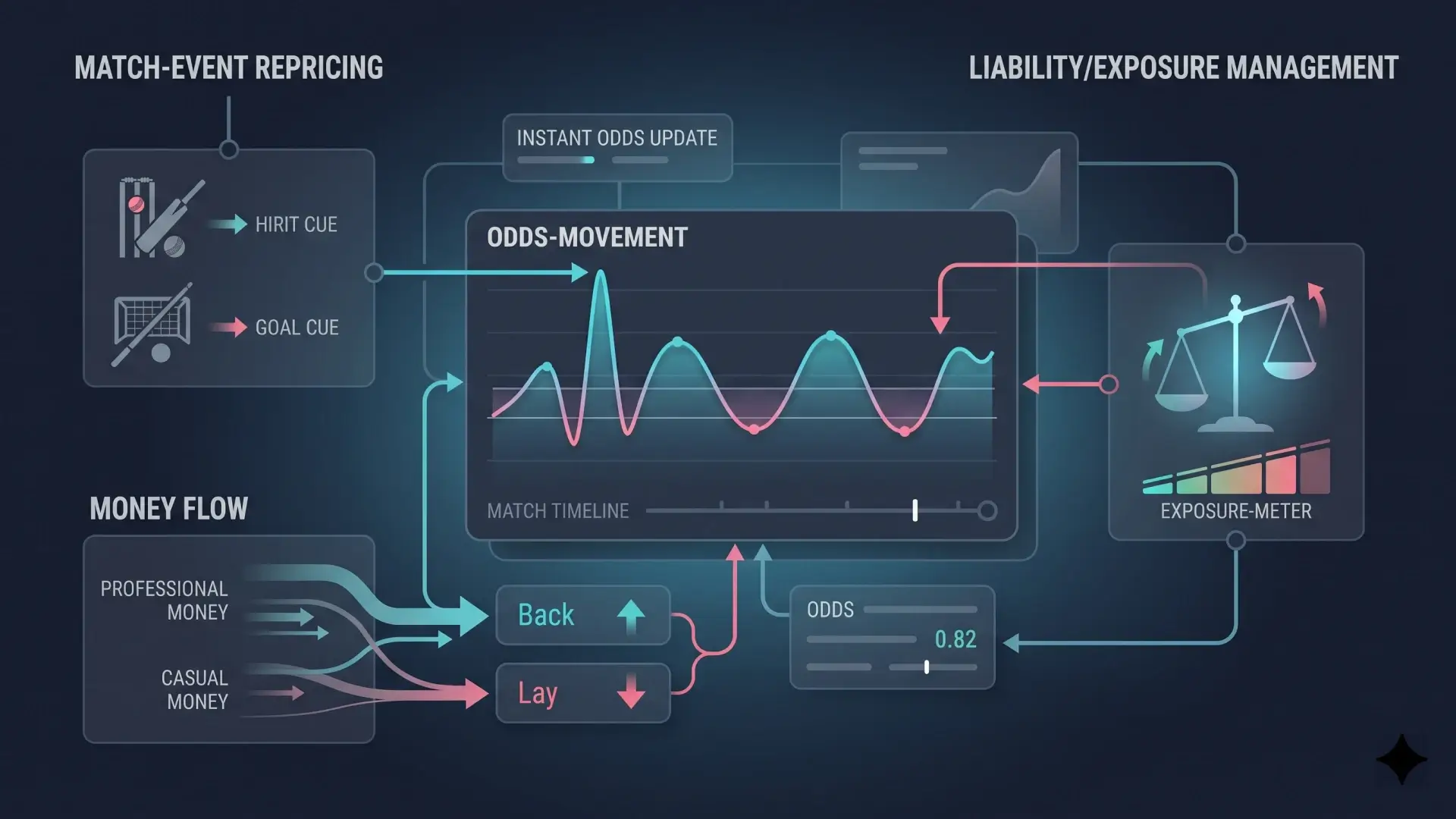
Each event on the field changes the mathematical probability of each available outcome. A wicket in over 14 of a T20 chase with 60 runs still needed changes the match-winner probability immediately. A goal in the 38th minute of a football match that had been scoreless changes the over/under line, the Asian handicap, and the match result market simultaneously. The bookmaker’s automated pricing model — which monitors ball-by-ball or event-by-event data feeds — reprices every affected market within seconds. This repricing is the mechanical baseline of all live odds movement and contains no exploitable information for the bettor because it is simultaneous across all platforms that use the same data feed.
FORCE 2: MONEY FLOW
Bets placed by bettors — both casual and professional — move odds through liability management. When a significant sum lands on one side of a market, the bookmaker shortens that side’s odds to reduce its attractiveness and lengthens the other side to encourage balancing action. The volume required to move a market varies by bookmaker size and by market liquidity. A major PSL final match-winner market may require hundreds of thousands of rupees or taka in one direction before the odds shift. A low-profile domestic football match may move on a fraction of that volume.
Money flow is the force that contains exploitable information when the money comes from professional bettors (sharps) who have identified a genuine mispricing. When the money comes from casual bettors (the public) who are reacting to recent events or backing emotional favourites, the movement contains much less information. The challenge — and the skill — is distinguishing which type of money is moving the market in any given situation.
FORCE 3: BOOKMAKER LIABILITY MANAGEMENT
Separate from aggregate money flow, bookmakers actively manage their exposure to specific outcomes based on their own customer profile. A bookmaker whose customer base is heavily weighted toward Bangladesh bettors may be overexposed to Bangladesh winning a home match — not because Bangladesh are genuinely more likely to win, but because more of their customers have backed Bangladesh. The bookmaker shortens Bangladesh’s odds to discourage further action and lengthen the opponent’s odds to attract offsetting bets. This is a liability management adjustment, not a probability assessment.
Liability management adjustments are the primary source of “artificially shortened” favourite odds — which Section 3 addresses in full. Recognising this type of movement allows you to identify when a favourite’s odds have been reduced by bookmaker position management rather than by genuine market information, and to judge whether the remaining price still represents value.
The margin: how to calculate exactly what a bookmaker is charging you
Before you can identify an artificially distorted price, you need to calculate the baseline cost of the market you are in — the bookmaker’s margin, also called the overround or vig. Without this figure, you cannot tell whether an individual set of odds represents value or an elevated price.
The overround formula
For any market with two or more outcomes, the overround is calculated as:
Overround (%) = (Sum of all implied probabilities) − 100%
Implied probability for each outcome = (1 ÷ Decimal Odds) × 100
EXAMPLE: FOOTBALL MATCH-WINNER MARKET
A bookmaker offers:
Home win: 2.10 → Implied probability: (1 ÷ 2.10) × 100 = 47.6%
Draw: 3.40 → Implied probability: (1 ÷ 3.40) × 100 = 29.4%
Away win: 3.60 → Implied probability: (1 ÷ 3.60) × 100 = 27.8%
Sum: 47.6 + 29.4 + 27.8 = 104.8%
Overround: 104.8 − 100 = 4.8%
This 4.8% is the bookmaker’s built-in edge across the three outcomes. If bets were evenly distributed across all three outcomes, the bookmaker would keep 4.8% of all stakes regardless of the result.
EXAMPLE: T20 CRICKET MATCH-WINNER MARKET (TWO OUTCOMES)
Pakistan win: 1.72 → Implied probability: 58.1%
India win: 2.20 → Implied probability: 45.5%
Sum: 58.1 + 45.5 = 103.6%
Overround: 103.6 − 100 = 3.6%
The two-outcome market has a lower overround than the three-outcome football market — this is typical across sports. More outcomes generally means a higher total margin because the bookmaker applies margin to each outcome individually.
What the overround tells you about value
A market with a 4.8% overround does not mean every individual outcome in that market carries a 4.8% edge for the bookmaker. Margins are rarely distributed equally. The favourite-longshot bias (Section 4) means the bookmaker typically charges more on longer-priced outcomes and less on shorter-priced ones. The home win at 2.10 in the example above may carry only a 2–3% bookmaker edge, while the away win at 3.60 may carry a 7–8% edge — despite the market’s headline overround being 4.8%.
What a fair margin looks like across market types
Betting exchanges (Betfair, BetSwiz, Smarkets): 2–3% commission on net winnings — the lowest cost market structure available
Sharp bookmakers (Pinnacle): 2–4% overround on major markets
Standard international bookmakers (Mostbet, 1win, Bet365 on major events): 4–7% overround
Standard bookmakers on minor markets (low-profile domestic cricket, lower league football): 8–15% overround
Live betting markets on all platforms: typically 1–3% higher than pre-match equivalent markets, reflecting the additional risk the bookmaker accepts by pricing in-play
The live betting premium is the most important figure for our purposes. A bookmaker that offers a 5% overround on pre-match football will often raise their live market overround to 7–8% because in-play pricing is harder to get right and the bookmaker needs additional margin to compensate for mispricing risk. When you calculate the live overround and find it is significantly higher than the same bookmaker’s pre-match overround for the same match type, you are paying a premium for the convenience of in-play access — and value bets become harder to find.
DO THIS BEFORE EVERY LIVE SESSION: Calculate the overround of the specific market you are entering. If the total implied probability exceeds 110%, the market is charging you more than the standard rate. Either find a better market on another bookmaker, use an exchange where available, or account for the elevated margin in your value assessment.
Artificial favourite shortening: how to spot it and what it signals
Artificial favourite shortening occurs when a bookmaker reduces the odds on the favourite not because of genuine information about the match outcome but because of their own liability exposure to that outcome. The favourite’s odds become shorter than the market’s genuine assessment of probability — meaning a bettor backing the favourite at the shortened price is paying more than the outcome’s actual probability warrants.
This is the specific pricing distortion that most live betting guides either miss or describe vaguely. Here is how to identify it with precision.
The signature of artificial shortening
A genuine probability-driven odds movement — caused by a match event or sharp money — moves simultaneously across multiple bookmakers. Within seconds of a wicket falling in a T20, every major bookmaker on the same data feed reprices their match-winner market in the same direction by a similar amount.
An artificial liability-driven shortening does not move across multiple bookmakers. It moves at one or two bookmakers whose customer base happens to be heavily exposed to that outcome, while other bookmakers hold their prices. The diagnostic question is therefore: is this movement happening at one bookmaker, or is it happening across the whole market simultaneously?
How to apply the diagnostic in practice
Step 1: Open the same market on two or three bookmakers simultaneously. Mostbet, 1win, Krikya sportsbook, and a major international book (Bet365, Pinnacle where available) are reasonable comparison points for Asian cricket markets.
Step 2: When the favourite’s odds shorten at one bookmaker during live play, immediately check the same outcome at the other bookmakers.
Step 3: If the other bookmakers have not moved or have moved by significantly less, the shortening is likely a liability management adjustment at the first bookmaker. This is a signal — not a certainty — that the first bookmaker’s price is now below fair value for the favourite. The implication: do not take the favourite at the shortened price at this bookmaker. If you want to back the favourite, use the bookmaker that has not moved.
Step 4: If all bookmakers have moved simultaneously, the cause is almost certainly a match event or cross-market sharp money. This is a genuine probability adjustment and the shorter odds at every bookmaker reflect the new market consensus.
The arbitrage implication
When one bookmaker shortens artificially and others hold, a temporary arbitrage window may exist: back the favourite at the non-moving bookmaker (still at fair value) and lay the favourite at the exchange (which prices closer to true probability). This window is brief — typically seconds to a few minutes — and requires accounts at multiple platforms open simultaneously. But recognising the artificial shortening is the first step, even for bettors who are not set up for arbitrage; it tells you which bookmaker is currently offering the better price for the favourite.
The bookmaker motivation
Liability management is the primary reason this happens, but it is worth understanding the bookmaker’s calculus. If a Bangladesh-focused bookmaker has taken significantly more money on Bangladesh to win than on their opponent, and Bangladesh then takes a wicket and moves toward a dominant position, the bookmaker’s existing liability on Bangladesh grows even more valuable to the bettor. To protect against a large Bangladesh payout, the bookmaker shortens Bangladesh’s odds further — discouraging additional Bangladesh backing and making the opponent’s odds more attractive to draw balancing action. The bookmaker is not making a statement about Bangladesh’s probability; they are managing their book’s exposure.
The favourite-longshot bias: where bookmakers load their real profit
The favourite-longshot bias is one of the most thoroughly documented phenomena in academic sports betting research, dating to Griffith (1949) and confirmed repeatedly across football, cricket, horse racing, and tennis. Its implication for live value betting is direct and practical: bookmakers do not distribute their margin equally across all outcomes.
What the bias means in plain terms
In a football match, a bookmaker might apply only a 2–3% margin to the heavy favourite’s odds while applying a 10–15% margin to the longshot’s odds. The total market overround of 7% masks the fact that the value distribution is highly unequal.
Concretely: in a match where the true (fair) probability is:
Home win: 70%
Draw: 20%
Away win: 10%
A bookmaker with 7% total overround might price these as:
Home win: 1.36 (implying 73.5% — only 3.5% above true)
Draw: 3.40 (implying 29.4% — 9.4% above true)
Away win: 5.50 (implying 18.2% — 8.2% above true)
The home win carries less margin than the other outcomes. The longshots (draw and away win) are priced with a heavier margin applied. A bettor who consistently backs heavy favourites on this type of market faces a smaller long-run disadvantage than one who consistently backs longshots — which is the practical implication of the favourite-longshot bias.
Why bookmakers do this
Three complementary explanations apply simultaneously:
Explanation 1 — Bettor psychology. Casual bettors overestimate the probability of rare outcomes. They are drawn to large potential payouts and willing to accept lower-than-fair odds on longshots because the nominal payout is large and exciting. Bookmakers exploit this preference by applying heavier margins where bettor sensitivity to price is lower.
Explanation 2 — Sharp bettor behaviour. Professional bettors focus on shorter-priced favourites because the mathematical edge per bet is more predictable and composable at scale. To avoid being consistently beaten on favourite markets by sharps, bookmakers keep favourite prices close to true probability to reduce the attractiveness of large sharp bets, while loading margin onto longshots where sharp activity is lower.
Explanation 3 — Risk management. A bookmaker who missets a longshot’s odds by 2% faces a small liability. A bookmaker who missets a heavy favourite’s odds by 2% faces a proportionally larger liability because more money is bet on the favourite. Conservative pricing on favourites reduces large-payout risk.
How to use this in live betting
In live cricket and football, the favourite-longshot bias means:
— The team that has just taken a dominant position in a match (odds shortening to 1.20–1.50 range) is typically priced closest to fair value by the bookmaker. The implied probability at these short odds is the most accurate figure in the market.
— The trailing team (odds lengthening to 5.00–10.00 range) is typically the most overpriced for the bookmaker. A substantial come-back bet on the trailing team late in a match carries a larger margin than it appears.
— In a live football market where the draw is priced at 3.20–4.00 during a 0-0 game, the draw probability is frequently underpriced in the implied odds relative to the true statistical probability of the game ending level. The draw at those odds may represent closer-to-fair value than either team win, because the bias loads margin on the higher-odds outcomes.
This is not a systematic strategy — it is a framework for understanding which outcomes in a live market are most and least fairly priced. Use it to direct your attention toward favourites when looking for value, and to maintain scepticism toward live longshot odds regardless of how attractive the nominal payout appears.
The odds drop signal: what a sharp sudden fall means — and when it is a trap
An odds drop is a significant, rapid reduction in the price of a specific outcome. In the context of live betting, this manifests as a team’s match-winner odds shortening from 2.40 to 1.90 within a two-minute window, or a total-runs line moving from 8.5 to 7.5 within a single over.
Odds drops attract attention because they suggest that someone with meaningful information has bet significantly on the shortened outcome. But odds drops are not uniformly informative — they have different causes that require different responses.
The four types of live odds drop
Type 1 — Injury or personnel change
A key player is injured during play and removed from the field. The team’s probability of winning drops immediately. The injured team’s odds lengthen; the opponent’s odds shorten. This is a fundamental repricing driven by real information and it is typically reflected across all bookmakers simultaneously within seconds of the official injury report or broadcast confirmation.
The trap: acting before the full information is available. If the player leaves the field temporarily (for assessment or equipment change) rather than being genuinely injured, the repricing may reverse quickly. Acting on the initial drop before the injury is confirmed can mean accepting a price that reverts within minutes.
The signal: if the odds drop persists across multiple bookmakers and the player does not return after several minutes, the injury is likely real. This is a genuine repricing, not noise. The value opportunity — if one exists — is at the opponent’s newly shortened odds, since the market has now moved to a more accurate assessment.
Type 2 — Weather and pitch change
In cricket, a sudden rain interruption changes the match’s effective target through Duckworth-Lewis-Stern calculations. Depending on which team benefits, odds move significantly. In football, a waterlogged pitch or heavy rain during a high-tempo match reduces scoring probability, shifting over/under markets downward.
Weather changes are visible to the bettor watching the broadcast — often before the bookmaker has fully processed the implications. This is one of the few live betting scenarios where a bettor with direct broadcast information genuinely has a timing edge over the bookmaker’s pricing model.
The trap: DLS calculations are complex and favour the team batting second in some scenarios while favouring the team batting first in others, depending on which wickets have been taken and which overs remain. Acting on a weather odds drop without understanding the DLS adjustment direction can mean betting against the correct repricing.
Type 3 — Sharp money surge
A professional bettor or syndicate has placed a significant bet on one outcome, forcing the bookmaker to reprice. This is the most discussed type of odds drop and the one most often incorrectly identified by recreational bettors.
The signal: sharp money typically moves the market before public betting does. If odds shorten before any visible on-field event, the cause is money flow. If that money is concentrated across multiple bookmakers simultaneously (a “steam move”), it is more likely to be coordinated sharp action than individual bettor activity.
The trap: chasing a steam move by betting after the drop means accepting the post-movement price — the worst available price for the outcome. Sharp money moves before the price moves. If you see the price after it has moved, the information that drove the sharp bet has already been incorporated into the odds. Betting at the post-move price does not give you the sharp bettor’s edge; it gives you a shorter price on an outcome that may or may not have genuine value at the new level.
Type 4 — Public betting surge
A popular team scores or takes a wicket, driving a wave of casual bets from fans in the moment. The bookmaker shortens the popular team’s odds and lengthens the opponent’s. This repricing contains less information than sharp money — it reflects emotional betting by the public, not analytical assessment.
The signal: public surges typically happen at one or two bookmakers with large consumer bases, not across the full market simultaneously. They often occur immediately after a broadcast event (a wicket or goal) that triggers emotional response from fans.
The trap: the public surge is exactly the type of odds drop most often mistaken for a sharp signal. The distinctive feature is timing — it arrives after the visible broadcast event (fans react) rather than before it (sharps act on information). It may also reverse partially as the bookmaker recognises the imbalance and adjusts back toward fair value.
How to evaluate any live odds drop in real time
Step 1: Note the time of the drop relative to any visible on-field event. Did the drop occur before, during, or after a broadcast event? Before = likely sharp money or information leak. During or immediately after = likely in-match event repricing or public surge.
Step 2: Check whether the drop is occurring at one bookmaker or across multiple platforms simultaneously. Single-book = liability management or public surge. Multi-book simultaneously = sharp steam move or in-match event repricing.
Step 3: Identify the magnitude. A 5–10% probability shift (e.g., 2.50 → 2.30) is within normal repricing range for an in-match event. A 30–40% probability shift (e.g., 3.00 → 1.80) in a two-minute window without a visible on-field event is a strong signal that significant information-driven money has entered the market.
Step 4: Do not react immediately. The value opportunity from a genuine sharp move has already closed by the time the price is publicly visible. Instead, use the drop to update your probability model and decide whether the post-drop price is still worth backing or whether you should look at the opponent’s newly lengthened odds.
Cross-bookmaker movement vs single-book movement: the distinction that matters
This section addresses the single most important diagnostic in live odds analysis. Every other assessment in this guide builds on this distinction.
CROSS-BOOKMAKER MOVEMENT (genuine signal)
When odds shorten simultaneously across multiple independent bookmakers — within seconds of each other, on the same outcome, without any identifiable on-field trigger — the movement contains genuine market information. Its sources are:
— The same data feed providing in-match event data to all platforms simultaneously
— Sharp bettors or syndicates operating across multiple books to avoid single-book detection and limits
— Arbitrage bettors exploiting a temporary discrepancy, whose activity forces convergence across the market
Cross-bookmaker movement is the signal that the market’s collective view of an outcome’s probability has genuinely changed. A bettor who wants to back that outcome should act quickly if the post-move price still offers value — the market is efficiently repricing and the window narrows rapidly.
Single-book movement (context-dependent signal)
When odds shorten at one bookmaker while others hold or move by a smaller amount, the movement is most likely:
— Liability management by that specific bookmaker (Section 3)
— Local public surge from that bookmaker’s specific customer base
— That bookmaker’s risk team manually repricing a specific market due to internal exposure
Single-book movement does not indicate that the true probability of the outcome has changed. It indicates that one bookmaker has decided to discourage further action on one side of their own book. For the bettor, this creates a temporary pricing gap: the outcome is available at a better price at the bookmakers that have not moved. That gap is the value window.
How to set up a cross-bookmaker comparison in practice
- Open at least two live match odds tabs simultaneously — one on a major platform (Mostbet, Bet365, Pinnacle) and one exchange (BetSwiz on Krikya, Betfair where available, Smarkets).
- The exchange price is your benchmark for true market probability. Exchanges carry lower margins (2–3%) than standard bookmakers and aggregate money from both casual and professional bettors without a built-in liability management adjustment. Exchange prices are the closest available proxy for the true market consensus.
- When a standard bookmaker’s price diverges from the exchange price by more than the expected margin difference (typically more than 0.10–0.15 in decimal odds for a major market), investigate the cause. If the exchange has not moved, the standard bookmaker’s move is not driven by genuine market information.
- A bookmaker’s favourite being priced at 1.65 while the same outcome trades at 1.80 on the exchange (corrected for the exchange commission) is a concrete signal that the bookmaker has shortened beyond fair value. The exchange is the market’s honest assessment; the 1.65 represents an artificially depressed price.
Reverse line movement: when the public and the market disagree
Reverse line movement (RLM) occurs when the odds move in the opposite direction to the majority of public bets placed on a market. If 70% of all bets placed on a cricket match are backing India, but India’s odds are lengthening rather than shortening, reverse line movement is in play.
Why rlm matters
In a standard market, heavy public backing on one side causes the bookmaker to shorten that side’s odds and lengthen the other side’s odds. If the public is backing India heavily but India’s odds are getting longer — not shorter — it means:
a) The bookmaker’s risk team has assessed that the public money is from casual bettors and is not changing their probability model. They are actually lengthening India’s price to attract balancing sharp action.
b) Sharp money is coming in on India’s opponent — overriding the effect of public India backing — causing a net movement in the opponent’s direction.
c) The bookmaker has insider exposure concerns about India (player availability, pitch assessment) and is pricing defensively.
All three interpretations suggest that India’s lengthened odds contain more potential value than a price that has simply drifted due to lack of interest. When the public and the market disagree — particularly when sharps appear to be driving the disagreement — the market’s direction tends to be more predictive than the public’s.
How to identify rlm in live cricket and football
In cricket live markets specifically, RLM patterns are most visible around powerplay and middle-over transitions. The batting team that just had two wickets fall may still attract heavy casual backing from fans (“they’ll recover”) while the odds continue to lengthen because professional traders are extending their lay positions against the batting team. This divergence — heavy casual backing, lengthening odds — is RLM in a cricket context.
In football live markets, RLM is most commonly observed around the 65–75 minute mark when a goal has been scored and casual bettors pile onto the leading team. If the leading team’s odds do not shorten further after the betting surge, professional money is balancing the market from the other side — either because they assess the leading team as correctly priced or slightly overpriced given the remaining minutes.
The limit of rlm as a signal
RLM is a directional indicator, not a bet trigger. Observing RLM on an outcome means that the market’s professional participants appear to disagree with the public’s assessment. It does not mean the market participants are correct. Sharps are wrong with measurable frequency, particularly in individual matches where match-specific factors (pitch behaviour, team selection decisions made in the last hour) are hard to assess even for professionals.
Use RLM as one signal in a broader value assessment, not as a standalone reason to back an outcome. When RLM aligns with your own analytical assessment — your read of the pitch, your knowledge of the batting lineup, your assessment of the required rate — the combination carries more weight than either signal alone.
Live odds in cricket: how events reprice the market and where gaps appear
Cricket’s ball-by-ball structure creates a specific live odds environment that differs from football. Each delivery is a discrete event with a defined outcome — dot ball, single, boundary, wicket, wide, no-ball — and each outcome triggers an immediate repricing. Understanding the repricing pattern allows you to anticipate when gaps are likely to appear.
The repricing speed hierarchy in cricket live markets
Data feed latency: The in-match data feed that bookmakers use to trigger repricing has a latency of approximately 2–5 seconds relative to the broadcast in most cases. A bettor watching a live broadcast sees the event before the bookmaker’s data feed registers it. This window — the 2–5 seconds between seeing a wicket fall and the bookmaker suspending the market and repricing — is the timing basis for the entry strategy in Section 10.
Market suspension: Every wicket in T20 live markets triggers an automatic market suspension, typically lasting 5–30 seconds, while the bookmaker reprices the match-winner odds, session runs odds, and other affected markets. The suspended period is not a betting window — it is when the bookmaker resets their model.
Where the gaps appear: The repricing after a wicket is usually accurate for the primary match-winner market. The secondary markets — session runs, over-by-over totals, fall of next wicket — are sometimes slower to reprice after a wicket because they involve more complex recalculation. A bettor who understands the match situation may find that an over-total line has not yet been adjusted to reflect a wicket that just fell two balls ago.
The five cricket events that create value windows
- Wicket on the first ball of a new spell. When a bowling change brings in a fresh pacer or spinner and they take a wicket immediately, the secondary markets (over total, session runs) have not yet updated to reflect both the bowling change and the wicket simultaneously. The net effect on the over total is larger than either event alone.
- No-ball that enables a free hit. The free hit ball — where the batting team cannot be dismissed — immediately adds one virtually guaranteed delivery to the over’s run production. If the bookmaker has not updated the over-total line to account for the free hit’s scoring impact, the over is underpriced.
- Rain interruption mid-over. A rain delay within a live over creates uncertainty about whether the over will be completed, whether DLS targets change, and how the bowling rotation is affected. Markets that suspend during the delay sometimes reopen at prices that do not fully account for the new match situation.
- Batting promotion in a T20 chase. When a team promotes a pinch-hitter in the 13th–15th overs of a chase, the batting order changes in a way that secondary markets (next wicket, session runs) may not immediately reflect. The promoted batter’s average score and dismissal probability differ significantly from the original expected batter.
- The 15th-over over-rate pressure. In T20s with over-rate penalties, a team that has fallen behind on overs faces additional pressure in the final stages. Some bookmakers’ live pricing models do not fully incorporate the over-rate penalty risk into the match outcome probability, creating a marginal underestimation of the batting team’s pressure.
How to use these windows
These are not guaranteed value situations — they are moments where the market’s automated repricing may lag behind a bettor’s situational awareness. Whether a specific gap represents genuine value depends on the actual match conditions, the strength of the batting lineup, and the pitch conditions. The cricket knowledge that makes these windows exploitable cannot be replaced by pattern recognition alone.
Live odds in football: the suspension events that create pricing gaps
Football live betting has a different structure from cricket. Events are less frequent, match-winner odds move more slowly between major incidents, and market suspensions are concentrated around a small set of specific trigger events.
The official suspension triggers in football live markets
Based on exchange documentation, football markets automatically suspend on the following events:
— Goal: immediate suspension across match-winner, Asian handicap, over/under goals, and next-goal scorer markets
— Penalty awarded: immediate suspension of match-winner and goals markets pending the outcome of the penalty
— Red card: immediate suspension for liability reassessment
— VAR review: suspension pending the official decision
— Significant injury (goalkeeper or key striker): manual suspension by risk team at most bookmakers
Each suspension is followed by a repricing and market reopening. The time between suspension and reopening varies from 5 to 60 seconds depending on the platform and the complexity of the repricing calculation.
Where gaps appear in football
The most common repricing gap in football live markets occurs around red cards. When a red card is shown, the immediate market reaction is to shorten the 10-man team’s odds of winning (increasing their probability of losing) and lengthen the odds of the opponent. But the statistical effect of a red card on match outcome is not as large as the immediate market reaction typically implies — particularly when the red card is shown before a goal changes the scoreline, when the dismissed player was a squad-depth player rather than a key attacker, and when significant time remains in the match.
Academic research on red card probability effects consistently finds that the immediate live market overreaction to red cards creates temporary value on the 10-man team, particularly when the red card comes in the first half (greater time for adjustment) and when the 10-man team is already leading or level rather than chasing.
The half-time transition window
In football, the period immediately before and after half-time creates a specific live odds window. The two-minute window before the end of the first half is the scenario specifically referenced in this guide’s brief — a period when last-minute first-half events (goals, red cards, injuries) can trigger sudden odds drops before the market processes the full half-time information.
What happens in this window:
— A goal in the 43rd–45th minute triggers an immediate repricing across all associated markets
— The bookmaker’s half-time suspended period (where they adjust to second-half pricing) follows immediately
— Injury news that emerges during half-time — a player who limped off in the 44th minute but has not been officially declared unavailable — may not be reflected in the bookmaker’s second-half pricing if the medical assessment is not complete
A bettor who has observed on the broadcast that a key player is being treated heavily at half-time — but the bookmaker’s second-half odds have not yet adjusted — has a brief window where genuine information (the player is likely not returning) has not been priced in. This window closes within minutes as the team sheet is confirmed and the data feed updates.
The bet delay in football live markets
Current bet delay for live football on major exchanges is 5–8 seconds per bet, depending on the league. On standard bookmakers, the delay is typically 6–10 seconds. For major European league football, exchanges have been reducing delays to 3 seconds in testing periods. On Betfair and equivalent exchanges, every second of delay in a high-volatility live market corresponds to approximately 0.8% decay in the realised value of the bet. At 8 seconds, the cumulative decay is approximately 6.4% — enough to turn a marginal value position into a break-even or negative-value one.
This is why Section 10’s entry timing guidance is specifically designed around pauses in play — the windows where odds are most stable and bet delay does the least damage.
Timing your entry: a step-by-step guide to beating bet delay
Bet delay is the automatic pause between clicking “place bet” on a live bet and the platform confirming the bet is accepted. The delay exists to protect the bookmaker against latency-based arbitrage — preventing a bettor who has seen a goal or wicket on a broadcast from placing a bet at pre-event odds before the data feed triggers the repricing.
Current standard delays as documented:
Cricket (major exchange): 5 seconds
Football (major exchange): 5–8 seconds depending on league
Football (standard bookmaker): typically 6–10 seconds; some platforms up to 16 seconds
Each second of delay in a fast-moving live market carries approximately 0.8% decay in the realised value of the bet, as confirmed by 2026 Predictology data analysis. At a 5-second delay on cricket, the decay is approximately 4%. At an 8-second football delay, it is approximately 6.4%.
The core principle: bet during pauses in play
The bet delay problem is at its most acute when odds are moving rapidly — during or immediately after an in-play event. The solution is to place bets not during fast-moving moments but during natural pauses in play where the odds have stabilised and the 5–8 second delay passes without significant movement.
The step-by-step entry timing guide
Step 1: Pre-identify your bet before the pause
Before any pause in play, identify the specific bet you intend to place — the outcome, the platform, and the price at which the bet represents value. Do this during play so the pause is not spent making the decision. In cricket T20: identify your bet during the mid-over period. By ball three of a six-ball over, you should know whether you are betting on the over total for that over, the next wicket market, or the match winner. In football: identify your bet during play so you can execute it the moment the ball goes out for a goal kick, corner, or throw-in from a dead-ball position.
Step 2: Open the bet slip before the pause begins
Navigate to the relevant market and open the bet slip during play, before the pause starts. Do not wait until the pause to open the market — the first seconds of a pause are consumed by navigation if you have not prepared.
Step 3: Enter your stake before the pause
With the bet slip open, enter your stake amount during the active play period. The bet slip should show your stake ready to confirm. You should not be typing your stake during the pause — you should be using the pause time exclusively for the final confirmation step.
Step 4: Execute at the start of the pause
The optimal execution moment is the first second of a natural pause in play: Cricket: the ball is dead after a delivery — either completed (dot ball, single, boundary) or interrupted (no-ball called, wide, wicket). The 10–15 seconds between deliveries is the pause window. Click confirm in the first second of this window. Football: the ball goes out of play for a throw-in, goal kick, corner, or free kick. This dead-ball period typically lasts 15–60 seconds. Click confirm in the first two seconds of the dead-ball period. Half-time in football: the period from the final whistle of the first half to the restart of the second half is the longest predictable pause in any football match. If your intended bet is on a second-half market, the half-time window is the ideal execution moment — odds have stabilised at half-time assessment levels, no active play is occurring, and the 5–8 second delay passes in a price-stable window.
Step 5: Verify confirmation before the next delivery
After clicking confirm, wait for the platform’s explicit confirmation — a bet slip acceptance message showing the bet is matched and the price at which it was accepted. Do not assume the bet was placed because you clicked confirm. Check that: a) The bet shows in your open bets list b) The accepted price matches the price you intended to bet at (within one tick for minor movement) c) Your account balance has decreased by the stake amount If the platform returns an “odds changed” notification during the delay, evaluate the new price immediately. If the new price still represents value at your assessment, confirm the new price. If the new price is no longer at value, decline and reassess.
Step 6: Handle rejection correctly
If a bet is rejected during a suspension (the market suspended during your 5–8 second delay), do not resubmit automatically. The suspension indicates a market event — a wicket, a goal, a card — has just occurred. The odds will reopen at a different price that reflects the new situation. Evaluate the new price from scratch rather than resubmitting the original bet at a price that no longer applies.
The fastest platforms for live bet confirmation
Documented 2026 data:
Betting exchanges (Betfair, Smarkets, BetSwiz): 5-second delay standard; 3-second in tested markets
Bet365 sportsbook: cited as the fastest-confirming major standard bookmaker for most live markets
Local Asian market bookmakers (Mostbet, 1win, Krikya sportsbook): delays typically 6–10 seconds depending on market and connection
Betconstruct-powered bookmakers: documented as having increased live betting time to 15–16 seconds in some configurations — avoid for time-sensitive live entry on rapidly moving markets
Broadband vs mobile connection
The bookmaker’s bet delay is server-side — it applies regardless of your connection speed. But your own connection adds latency on top. A mobile 3G connection in Bangladesh or Pakistan may add 300–600 milliseconds of additional latency relative to a 4G or WiFi connection. While this is small relative to a 5-second delay, on very short delays (1–3 seconds for specific exchange markets) it becomes meaningful. Use a WiFi or stable 4G connection for live betting sessions where timing matters.
The complete value bet checklist: seven questions before confirming any live bet
This section is a consolidation of every analytical step covered in this guide into a single pre-confirmation checklist. Apply it to every live bet before clicking confirm.
QUESTION 1: HAVE I CALCULATED THE OVERROUND?
Calculate the implied probability of all outcomes in the market. If the total exceeds 108–110% on a two-outcome market, the margin is too high to find consistent value. Move to an exchange or a sharper bookmaker.
QUESTION 2: IS THE MOVEMENT I AM RESPONDING TO CROSS-BOOKMAKER OR SINGLE-BOOK?
Check the same outcome on at least one other platform. If only one bookmaker has moved, the cause is likely liability management, not genuine market information. Do not chase single-book movement; find the better-priced outcome at the bookmakers that have not moved.
QUESTION 3: WHAT TYPE OF ODDS DROP AM I SEEING?
Apply the four-type diagnostic from Section 5: injury/personnel, weather, sharp money, or public surge. The only type where betting on the shortened outcome makes sense is weather (where you have independent broadcast information ahead of the data feed repricing). For all other types, acting after the drop means accepting the worst available price.
QUESTION 4: IS THE FAVOURITE-LONGSHOT BIAS WORKING FOR OR AGAINST THIS BET?
If you are backing the favourite (short odds), the margin structure is working in your relative favour — you are in the most fairly priced part of the market. If you are backing the longshot (long odds), the margin structure is working against you — the bookmaker has likely applied disproportionate margin to this outcome.
QUESTION 5: IS THERE REVERSE LINE MOVEMENT?
Is the public heavily on the other side while this outcome’s price is moving your way? If yes, the market’s professional participants appear to disagree with the public. This supports your position if your own assessment also supports it.
QUESTION 6: DOES THIS BET HAVE A NATURAL PAUSE TO EXECUTE IN?
Is there a dead-ball period, a wicket break, a half-time window, or a throw-in window in the next 60 seconds where you can execute without competing against rapidly moving odds? If not, wait for one. A bet placed at a stable price during a pause is better than a bet placed during live action at a moving price.
QUESTION 7: DOES THE PRICE STILL REPRESENT VALUE AFTER COMMISSION?
If you are using an exchange, subtract the commission rate from your expected profit to calculate the net value. If the adjusted expected value is positive — based on your probability assessment minus the margin cost — the bet has value. If not, it does not.
A bet that passes all seven questions is a value bet by the analytical standards of this guide. A bet that fails any one of them should be reconsidered, reduced in stake, or abandoned until the conditions improve.
The discipline note
The checklist should take approximately 30–45 seconds to complete for an experienced bettor who has practised it. New bettors should take longer. A live bet that cannot be evaluated against all seven questions in the available pause window is a bet that should not be placed in that pause — wait for the next opportunity.
The value bet framework in this guide does not guarantee winning bets. It guarantees that the decisions you make are grounded in the available information rather than in reaction, urgency, or the fear of missing a move. Over a large enough sample of bets made this way, the analytical process improves outcomes relative to the alternative. That is what “securing value” means — not certainty on any individual bet, but a systematic process that is better than the market’s public average over time.
Responsible betting note
Live betting markets move quickly and multiple decisions are required within short time windows. The analytical framework in this guide is designed to slow down the decision-making process and prevent reactive, impulsive bets. If you find that live betting sessions are causing financial stress, anxiety, or impulsive stake escalation regardless of the analytical framework, the pace of live markets may not be suitable for your current relationship with betting.
All betting platforms discussed in this guide offer deposit limits and self-exclusion tools in account settings. Set a maximum stake per live bet before opening any session, and a maximum session loss before your first bet is placed. The framework in this guide is only as useful as the discipline applied outside the framework.
18+ only. Legal status of live sports betting varies by jurisdiction — verify the regulatory position in your country before opening accounts.