
Cricket betting school: how to use exchange markets (back & lay) to risk-free your bets
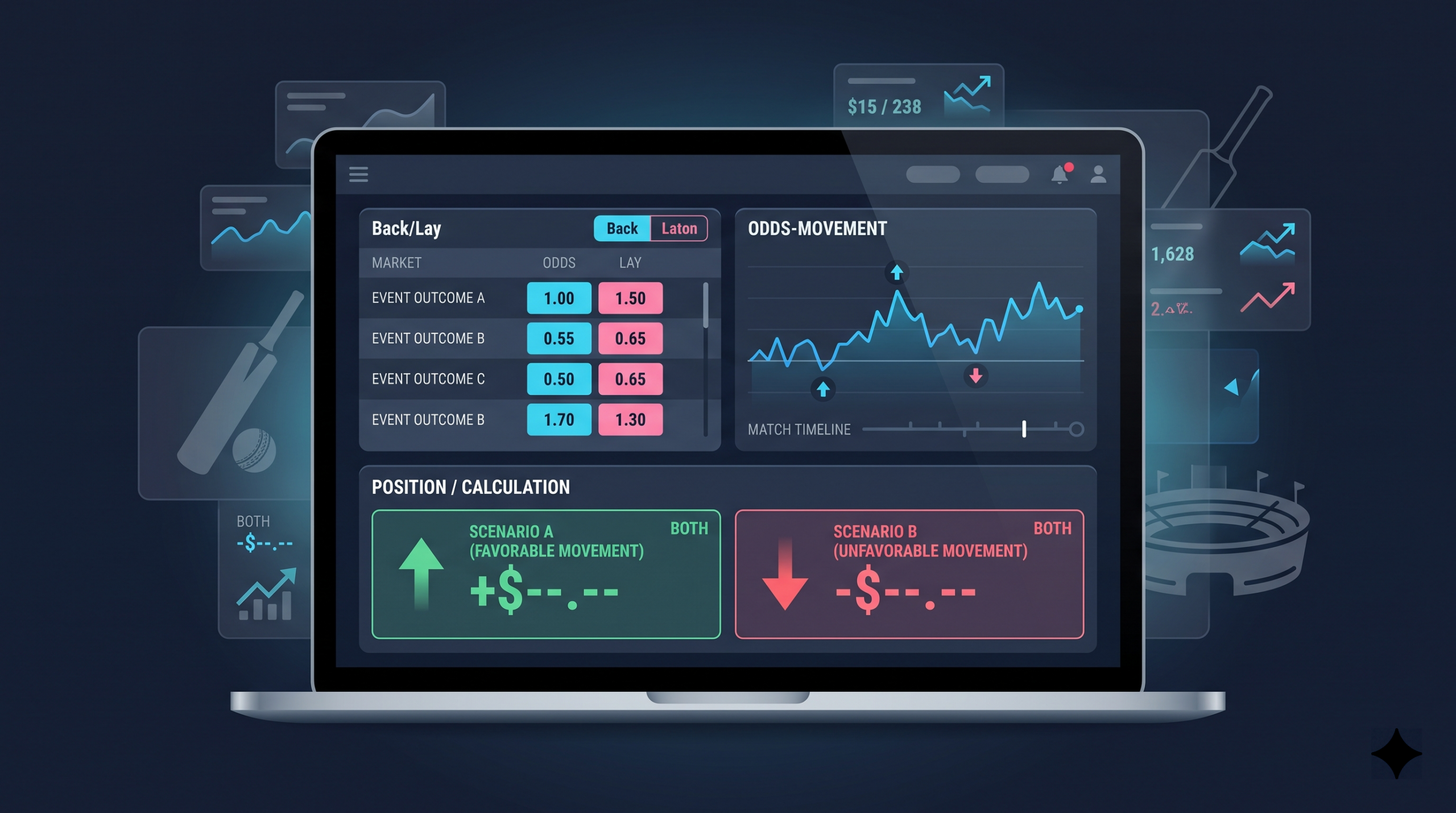
This guide teaches the mechanics of cricket betting exchanges: what back and lay bets are, how odds move during a T20 match, how to calculate a guaranteed profit at the 15th over when your original position has moved significantly in your favour, and how to structure your bankroll so that a losing run does not end your ability to continue betting.
It does not promise that exchange trading is profitable long-term for every player who reads it. The guaranteed profit described in Section 06 is real — the maths works — but it only produces a profit when the odds have moved in your original direction. If odds move against you, the same mechanics produce a guaranteed loss, a stop-loss, or a damage-control position. Both outcomes are possible. The cricket does not cooperate with your trade just because the trade is well-structured.
What the guide does offer is a framework: the ability to define your risk precisely before every trade, to choose between holding a position and closing it for a known outcome, and to manage your bankroll in a way that keeps you in the market through variance long enough for skill to express itself. Those are the practical benefits of exchange literacy. They are worth learning regardless of whether you ultimately generate consistent profit, because they replace uninformed guessing with informed decisions.
This is the distinction that matters: exchange trading is not a system that removes risk. It is a system that makes risk visible, calculable, and manageable. That is what this school teaches.
The betting exchange in plain language — what it is and who you are betting against
A traditional sportsbook operates as follows: you place a bet with the bookmaker, the bookmaker sets the odds and takes the other side of your bet, and the bookmaker’s margin (built into the odds) ensures long-term profitability for the house. You are always betting against the platform.
A betting exchange operates differently. The exchange is a marketplace — a platform that connects bettors who want to be on opposite sides of the same outcome. You do not bet against the exchange; you bet against another person. The exchange simply matches the two sides, facilitates settlement, and charges a small commission on net winnings.
Consider a T20 match: India vs Pakistan. On a traditional sportsbook, India’s match-winner odds are set by the platform’s pricing team. On a betting exchange, the odds are set by the first player who posts an offer. A second player accepts that offer and the bet is matched. Both players are real participants who have decided the offered odds represent value from their respective positions.
The practical consequences of this structure:
TIGHTER ODDS. Because the exchange earns only commission rather than a built-in margin, the odds available on exchanges are typically better for the bettor than equivalent sportsbook odds on the same market. The margin that would otherwise belong to the bookmaker largely passes to the bettor through improved pricing.
TWO-DIRECTIONAL MARKETS. On a sportsbook, you can only bet that something happens. On an exchange, you can also bet that something does not happen — by taking the other side of someone else’s back bet. This is called laying, and it is the foundation of every technique in this guide.
IN-PLAY REPRICING. Exchange odds update continuously during a live match — after every wicket, boundary, maiden over, and power play decision. This creates a live market that reflects the evolving probability of each outcome in real time. A bettor who placed a position before the match can close it during the match at the current price, exactly as a financial trader closes a position before the market closes.
COMMISSION ON NET WINNINGS. The exchange’s revenue comes from a percentage of your net profit on each settled market. If you win a market, you pay commission. If you lose, you do not. The rate varies by exchange: typically 2% on Smarkets-style platforms and 5% on Betfair’s standard rate, though promotional rates and loyalty tiers can reduce this. Commission does not change the basic mechanics of back and lay bets, but it changes every calculation by a meaningful amount. Section 08 covers this in full.
Back bets: the mechanics, the payout, and the limit of your risk
A back bet is the familiar side of betting. You back an outcome — you bet that it will happen. If it happens, you win. If it does not happen, you lose your stake.
Exchange odds are expressed in decimal format. The decimal odds represent the total payout per unit staked, including the return of your original stake.
Back bet formula
Profit if your selection wins = (Decimal Odds − 1) × Stake
Loss if your selection loses = Stake (the full amount staked)
Example
You back India to win a T20 match at decimal odds of 2.50. Your stake: 1,000 units.
If India wins:
Profit = (2.50 − 1) × 1,000 = 1.50 × 1,000 = 1,500 units
Total returned: 2,500 units (1,500 profit + 1,000 stake)
If India loses:
Loss = 1,000 units (your entire stake)
Your maximum risk on a back bet is always your stake
This is the defining feature of a back bet from a risk management perspective. You know, before you click confirm, exactly how much you can lose: the amount you staked. You cannot lose more than your stake on a back bet. This makes back bets straightforward to incorporate into bankroll rules — the 2–5% bankroll rule in Section 09 is directly applied to the back stake.
Unmatched back bets
When you request a back bet at a specific price, it enters the market as an order. If another player has already offered to lay that outcome at the same or better price, your bet is matched immediately. If no layer is available at your price, your bet sits as an unmatched order — it is not placed and no funds are committed until it is matched. For live in-play cricket, unmatched orders can expire as the market moves rapidly. Always confirm your bet has been matched before assuming it is in play.
Lay bets: the mechanics, the liability formula, and why the stake is not the risk
A lay bet is the bookmaker’s position. When you lay an outcome, you are betting that it will not happen. You are taking the other side of a back bet placed by another player.
If the outcome does not happen, you collect the backer’s stake — your “stake” in the lay market. If the outcome does happen, you pay out at the agreed odds — your “liability.”
This is the critical distinction that most new exchange bettors miss: on a lay bet, your visible “stake” is what you stand to win, not what you stand to lose. What you stand to lose — your liability — is a multiple of that stake, determined by the odds.
The liability formula
Liability = Stake × (Lay Odds − 1)
This formula must be memorised. It is the only calculation that separates controlled lay betting from accidental large-loss betting.
Example 1: low-odds lay
You lay India to win at odds of 1.50. Your lay stake: 1,000 units.
Liability = 1,000 × (1.50 − 1) = 1,000 × 0.50 = 500 units
If India does NOT win: you collect 1,000 units (the backer’s stake)
If India DOES win: you pay 500 units (your liability)
At 1.50 lay odds: you risk 500 units to win 1,000 units. Your liability is half your potential win. This is a low-liability lay.
Example 2: high-odds lay
You lay India to win at odds of 4.00. Your lay stake: 1,000 units.
Liability = 1,000 × (4.00 − 1) = 1,000 × 3.00 = 3,000 units
If India does NOT win: you collect 1,000 units
If India DOES win: you pay 3,000 units
At 4.00 lay odds: you risk 3,000 units to win 1,000 units. Your liability is three times your potential win. This is a high-liability lay.
The exchange reserves your liability in advance
When you place a lay bet, the exchange immediately reserves the full liability amount from your account balance. You cannot place a lay bet if your account does not contain sufficient funds to cover the liability. This is the safety mechanism that prevents accidental over-exposure — but it also means your exchange account needs to hold more than just your intended “stake” for lay positions.
The ceiling rule for lay bets
From the liability formula, a practical ceiling follows: never lay at odds above the point where the liability-to-win ratio becomes unsustainable for your bankroll. The specific ceiling depends on your bankroll, but a working rule for cricket exchange trading is to restrict lay bets to odds below 4.00 when learning the market, and below 2.50 for low-risk trading specifically. Above 4.00, a single loss requires multiple wins to recover.
Why low-odds lays are the foundation of the 15th-over trade
The guaranteed-profit technique in Section 06 involves laying a team that has become a strong favourite during a T20 match. Strong favourites in live cricket typically trade at odds between 1.20 and 1.80. At these prices, the liability is manageable: laying at 1.40 for a 1,000-unit stake produces a liability of only 400 units. This is why trading into a winning position produces a bounded, predictable risk — not an open-ended one.
The spread: back price, lay price, and what the gap costs you
Every outcome on a betting exchange displays two prices simultaneously: the back price (the higher number, displayed in blue) and the lay price (the lower number, displayed in red or pink). These two prices are not the same, and the gap between them — called the spread — has a direct cost for every trade you make.
How the spread appears
In a T20 match winner market, India’s odds might display as:
Back: 2.10 | Lay: 2.12
If you want to back India now, you get odds of 2.10. If you want to lay India now, you offer odds of 2.12 (meaning the person backing India gets 2.12, and you accept that liability).
The spread here is 0.02 — two ticks. In a liquid market (a major T20 international or PSL game with high betting volume), spreads are very tight and the cost is small. In an illiquid market (a low-profile domestic fixture with few participants), spreads can be 0.10 or wider, and the cost of entering and exiting a position eats significantly into any trading profit.
What the spread means for your trade
If you back India at 2.10 and want to close the position (by laying India) without the match odds moving at all — purely as an entry/exit exercise — you would lay at 2.12. Your effective exit price is 2.12 when your entry was 2.10. You have paid 0.02 of odds movement just to enter and exit. On a large stake, this cost compounds.
The practical rule: only trade in high-liquidity markets where spreads are one or two ticks. Low-liquidity markets look attractive because their odds may be generous, but the wide spread makes it expensive to close a position efficiently. For cricket, this means focusing on major international matches, PSL finals and knockout stages, IPL (and India matches generally), and BPL flagship fixtures rather than low-profile domestic group games.
The three-price ladder
The exchange display typically shows three available prices on each side — the three best back prices and the three best lay prices, with the volume available at each price. This matters when your required trade size exceeds the volume available at the best price. If you want to back 10,000 units and only 4,000 units are available at 2.10, the remaining 6,000 units will be matched at 2.08 or lower. Your effective entry price is worse than the headline figure.
Always check the volume at the best price before placing a large order. If the volume is smaller than your intended stake, either accept the average price, reduce your stake to what the best price can absorb, or wait for more volume to enter the market.
How odds move during a t20 match — the engine that makes trading possible
Trading a cricket exchange position depends entirely on odds movement. If odds never moved during a match, there would be nothing to trade — your back price would be the same as your lay price at any point during the game, and closing a position would always produce zero profit.
Odds move because each event in a cricket match changes the probability of each outcome. The exchange’s collective participants continuously reassess the match’s probability and update the prices they are willing to accept. Understanding how and when odds move allows you to identify trading opportunities before they close.
The five events that move match odds most significantly
Event 1: Wickets. A wicket in a T20 chase is the most powerful single odds-moving event in cricket. Particularly in overs 15–18, a wicket reduces the number of capable batters available for the remaining balls and shifts the balance of the match toward the bowling team. When a set batter in the 40s or 50s is dismissed, the chasing team’s odds lengthen immediately — often by 0.20 to 0.50 in a single ball. When a batting collapse occurs (two or three wickets in rapid succession), odds can shift by 1.00 or more within a few overs.
Event 2: Powerplay boundaries. In the first six overs of a T20 innings, boundaries disproportionately shift the match’s probability because they occur under fielding restrictions. A team scoring 60+ in a powerplay on a flat pitch creates immediate pressure on the bowling team’s match odds. Conversely, a team losing two wickets in the powerplay before scoring 30 shifts odds strongly toward the bowling side.
Event 3: Run-rate divergence. As the match progresses, the gap between the current run rate and the required run rate becomes increasingly decisive. At over 15, a team needing 12 runs per over for the remaining five overs faces a significantly different probability distribution than a team needing 7 runs per over. The exchange prices this gap in real time. A bettor who backed the chasing team at 3.00 (33% implied probability) before the match and watches them move to a position requiring 7 per over from over 15 has watched their odds shorten substantially — from 3.00 to perhaps 1.60 — and this movement is where the trade becomes executable.
Event 4: Toss and pitch revelation. The toss determines batting or fielding order and is revealed before any bet is matched in some exchange configurations. Pitch conditions (visible in the pre-match pitch report and early overs) influence expected first-innings totals. A team winning the toss and choosing to bat on a flat Lahore pitch moves to shorter odds immediately. A team sent in on a seaming Karachi surface with early cloud cover may move to longer odds than pre-toss pricing reflected.
Event 5: DLS adjustment and rain interruption. A rain interruption that applies Duckworth-Lewis-Stern calculations changes the match’s effective target and can move odds dramatically depending on which team benefits from the revised target. Rain during a T20 is an exchange risk that cannot be predicted or traded around reliably — it is one of the few scenarios where holding a back position may produce a surprise outcome unrelated to the cricket itself.
The pattern for trading opportunity
In a T20 match, the largest and most sustained odds movements typically occur between overs 10 and 18 of the second innings (the chase). This is because:
— The match’s outcome is increasingly determined as fewer overs remain
— Wickets in this phase have an outsized impact on run-rate sustainability
— The required run rate becomes visible and measurable rather than theoretical
A bettor who backed the chasing team before the match at odds of 3.00 should be actively monitoring the match from over 10 of the second innings. If the chasing team is on track — required rate is manageable, wickets in hand are sufficient — the odds will be shortening. By over 15, if the required rate is within reach and 6–7 wickets are in hand, the odds may have moved from 3.00 to 1.60. This is where Section 06’s calculation becomes executable.
The 15th-over trade: locking in guaranteed profit with arithmetic
This is the central technique of the guide. It produces a guaranteed profit — in both outcomes — when the exchange odds have moved significantly in the direction of your original back bet. The profit is not hypothetical: it is a fixed, calculable BDT (or any currency) amount that will be in your account regardless of whether the match ends in your original selection winning or losing.
The setup
You backed Pakistan (chasing team) to win a T20 match at odds of 3.00 before the match. Your stake: 1,000 units. (Replace units with BDT, PKR, or any relevant currency throughout.)
Before the match, your position was:
If Pakistan wins: profit = (3.00 − 1) × 1,000 = 2,000 units
If Pakistan loses: loss = 1,000 units
Pakistan bats. At the 15th over, they need 54 runs from 30 balls with 7 wickets in hand. The crowd is behind them. The match-winner odds on the exchange now show Pakistan at 1.60. The odds have moved from 3.00 to 1.60 — a significant shortening that reflects Pakistan’s dominant position.
You want to lock in a guaranteed profit. To do this, you lay Pakistan at the current odds of 1.60.
The lay stake formula for guaranteed profit
The lay stake that produces equal profit in both outcomes is:
Lay Stake = (Back Stake × Back Odds) ÷ Lay Odds
Lay Stake = (1,000 × 3.00) ÷ 1.60
Lay Stake = 3,000 ÷ 1.60
Lay Stake = 1,875 units
Now calculate the outcome in both scenarios:
SCENARIO A — PAKISTAN WINS:
Your back bet pays: 1,000 × 3.00 = 3,000 units returned (2,000 profit)
Your lay bet loses: you pay the backer’s profit
Lay liability = 1,875 × (1.60 − 1) = 1,875 × 0.60 = 1,125 units paid out
Net position: 2,000 − 1,125 = +875 units profit
SCENARIO B — PAKISTAN LOSES:
Your back bet loses: 1,000 units lost
Your lay bet wins: you collect 1,875 units (the backer’s stake)
Net position: 1,875 − 1,000 = +875 units profit
In both outcomes: +875 units. That is the guaranteed profit from this trade, executed at the 15th over.
You started with a back bet that could lose 1,000 units or profit 2,000 units — a binary risk/reward. After the lay, you have converted it into a position that pays 875 units regardless of what happens in the final five overs. The uncertainty is gone. The 875-unit profit is locked.
Understanding why the profit is equal in both outcomes
The formula Lay Stake = (Back Stake × Back Odds) ÷ Lay Odds is specifically designed to equalise the profit in both outcomes. When you use this formula, the symmetry is guaranteed. If you use a different lay stake — either larger or smaller — the profits will be unequal: one outcome will produce more than the other. An asymmetric book is not wrong — it is a choice about which outcome you prefer more exposure to. But equal profits in both outcomes is the standard “green book” that traders aim for when they want to fully exit a position.
The impact of commission on the actual profit
The 875-unit guaranteed profit is the pre-commission figure. The exchange charges commission on the winning side of each market. When Pakistan wins, your back bet market profit is 2,000 units before commission. If the commission rate is 2%, your net profit from the back bet market is 2,000 × (1 − 0.02) = 1,960 units. The lay bet liability payment comes from this gross figure.
The adjusted calculation with 2% commission:
SCENARIO A — PAKISTAN WINS:
Back bet gross profit: 2,000 units
Commission on back bet win: 40 units (2% of 2,000)
Net back bet profit: 1,960 units
Lay liability paid: 1,125 units
Net position: 1,960 − 1,125 = +835 units
SCENARIO B — PAKISTAN LOSES:
Back bet loss: 1,000 units
Lay bet gross win: 1,875 units
Commission on lay bet win: 37.5 units (2% of 1,875)
Net lay bet win: 1,837.5 units
Net position: 1,837.5 − 1,000 = +837.5 units
With 2% commission, the guaranteed profit is approximately 835–837.5 units rather than 875. At 5% commission (Betfair standard rate), the guaranteed profit falls further — to approximately 780–790 units. This is why Section 08 emphasises knowing your commission rate before calculating any trade.
The practical implication: always calculate with commission included. The pre-commission figure is a ceiling, not the actual outcome.
When the trade is worth executing
The 15th-over trade is worth executing when:
— The back odds have moved sufficiently far from your original price to produce meaningful guaranteed profit. A movement from 3.00 to 2.80 produces a small green book; a movement from 3.00 to 1.60 produces a substantial one. Check the calculation before deciding — the number tells you whether it is worth locking now or waiting for further movement.
— The match situation is volatile enough that the remaining overs could still reverse the position. If Pakistan needs 54 from 30 with 7 wickets, they are favourites but not certainties. Locking the profit at over 15 is rational because the final 30 balls can still produce a collapse, a rain delay, or a fielding restriction violation. Waiting until over 19 for a larger green book risks losing the position entirely if those 30 balls go badly.
— The lay market has sufficient liquidity at your required price. If you need to lay 1,875 units at 1.60 and only 800 units of volume is available at that price, your order will not be fully matched at 1.60 — part of it will execute at 1.62 or 1.64, changing the calculation. Check volume before committing.
The loss-cut trade: using the exchange to limit a losing position
The guaranteed-profit trade in Section 06 applies when odds have moved in your favour. The equivalent technique for when odds have moved against you is the loss-cut trade: closing a deteriorating position for a known, bounded loss rather than letting it run to its maximum loss potential.
The setup
You backed Pakistan at 3.00 for 1,000 units before the match. Pakistan loses three wickets in the powerplay and collapses to 25/3 at over 6. Their match-winner odds have moved from 3.00 to 6.50 — the market has significantly reduced Pakistan’s probability of winning.
Your current position if you do nothing:
If Pakistan wins: +2,000 units
If Pakistan loses: −1,000 units
But with Pakistan at 25/3 and needing a substantial score from the remaining overs, the probability of the +2,000 outcome has diminished substantially. The question is whether to hold or cut.
The loss-cut calculation
To close the position for a defined loss, you lay Pakistan at the current odds of 6.50. The lay stake that equalises the outcome (produces the same result whether Pakistan wins or loses) uses the same formula:
Lay Stake = (Back Stake × Back Odds) ÷ Lay Odds
Lay Stake = (1,000 × 3.00) ÷ 6.50
Lay Stake = 3,000 ÷ 6.50
Lay Stake = 461.5 units (round to 462 units)
Calculate both outcomes:
SCENARIO A — PAKISTAN WINS:
Back bet profit: 2,000 units
Lay liability: 462 × (6.50 − 1) = 462 × 5.50 = 2,541 units paid
Net position: 2,000 − 2,541 = −541 units
SCENARIO B — PAKISTAN LOSES:
Back bet loss: 1,000 units
Lay bet win: +462 units collected
Net position: 462 − 1,000 = −538 units
In both outcomes: approximately −540 units. You have converted a binary position of {−1,000 or +2,000} into a fixed loss of approximately −540 units regardless of the match result.
Why this is rational when the position has deteriorated
The original position had a maximum loss of 1,000 units. After cutting, the guaranteed loss is approximately 540 units — roughly half the maximum. You have accepted a certain loss of 540 in exchange for eliminating the risk of a 1,000-unit loss.
Whether this is correct depends on your assessment of Pakistan’s remaining probability. If you believe Pakistan’s collapse at 25/3 has genuinely reduced their winning probability to below 15%, the 3.00 original price was effectively wrong — they are now a 6.50 shot and your position reflects a negative expected value going forward. Cutting at −540 is rational. If you believe the 25/3 position is recoverable with strong middle-order batting, and the 6.50 price overestimates the collapse’s significance, holding and accepting the binary {−1,000/+2,000} outcome is a genuine choice.
The exchange does not make this decision for you. It gives you the tool to implement whichever decision you make with precision.
The asymmetric loss-cut
The equalised loss-cut (−540 in both outcomes) is one choice. You can also lay a smaller amount to create an asymmetric position: you still lose if Pakistan loses, but you lose less than 1,000 units if they do. The trade-off is that if Pakistan wins, you win less than 2,000 units.
For example, laying 300 units at 6.50 instead of 462:
Lay liability: 300 × 5.50 = 1,650 units
If Pakistan wins: 2,000 − 1,650 = +350 units profit
If Pakistan loses: 300 − 1,000 = −700 units loss
This preserves upside if Pakistan recovers while reducing the downside from 1,000 to 700. It is a hedge rather than a full closure. Use it when you want to maintain exposure to the upside but reduce the loss if the position continues to deteriorate.
Commission: the invisible cost that changes every calculation
Exchange commission is charged on your net profit in each settled market. It is the exchange’s revenue source and it applies only when you win — if you lose a market, no commission is deducted.
Commission rates vary by platform and by loyalty tier:
Standard retail rate: 5% (Betfair standard, before any discount)
Competitive exchange rate: 2% (Smarkets, some promotional tiers)
Platform-specific: Krikya’s BetSwiz Exchange and Dream Exchange carry their own commission structure — verify the current rate in the exchange interface before trading, as it affects every calculation in this guide
What commission does to your green book
The guaranteed-profit calculation in Section 06 produced 875 units pre-commission. At various commission rates:
0% commission: 875 units (theoretical maximum)
2% commission: approximately 837 units
5% commission: approximately 791 units
The difference between 2% and 5% on a 875-unit green book is approximately 46 units. Across a month of regular trading, this gap compounds significantly. A bettor who trades 50 markets per month at an average green book of 500 units loses 1,150 units more in commission per month at 5% than at 2% — equivalent to over two full stakes at standard position sizing.
How to include commission in the lay stake formula
The commission-adjusted lay stake formula is:
Lay Stake = (Back Stake × Back Odds) ÷ (Lay Odds − Commission Rate)
At 2% commission, for the Section 06 example:
Lay Stake = (1,000 × 3.00) ÷ (1.60 − 0.02)
Lay Stake = 3,000 ÷ 1.58
Lay Stake = 1,898.7 units (round to 1,899)
Using 1,899 rather than 1,875 adjusts the lay stake slightly upward to compensate for commission, producing a more precisely equalised green book after commission is deducted.
For most practical trading at 2% commission, the unadjusted formula is close enough and the difference is a few units. At 5% commission, the adjustment becomes more material and should always be applied.
The rule: always verify your commission rate before the first trade of the session
Commission rates can change. Exchange platforms adjust rates as part of promotional periods, and VIP tier rates are tied to rolling wagering volumes that reset periodically. Check the rate displayed in the exchange interface at the start of every session. Do not assume last month’s rate applies today.
Bankroll management: the 2–5% rule and why it is mathematically necessary
The 2–5% bankroll rule states that no single exchange position should risk more than 2–5% of your total available trading bankroll. For exchange trading, “risk” means the maximum amount you can lose on the position — the back stake (for back bets) or the lay liability (for lay bets).
This rule is not a suggestion or a conservative preference. It is a mathematical requirement for surviving variance long enough for skill to express itself.
The mathematics of ruin without the rule
Imagine a bankroll of 20,000 units and a series of positions each staked at 10% of the starting bankroll (2,000 units per trade). After 10 consecutive losses:
Starting: 20,000
After 1 loss: 18,000
After 2 losses: 16,000
After 5 losses: 10,000
After 10 losses: 0 units
Ten consecutive losses at 10% per trade exhaust the bankroll entirely. A ten-trade losing run is not a catastrophic anomaly — it is within normal statistical variance for a bettor with a genuine edge who is unlucky in a short sample. No edge, no matter how real, protects against ruin if stakes are too high.
Now apply the 5% rule to the same bankroll:
Starting: 20,000
After 1 loss: 19,000
After 5 losses: approximately 15,800
After 10 losses: approximately 12,500
After 20 losses: approximately 7,900
Twenty consecutive losses at 5% per trade still leave a viable trading bankroll. Recovery from 7,900 to 20,000 requires 150% growth — difficult, but achievable from a functioning bankroll. Recovery from 0 is not achievable.
The lay bet application of the rule
For back bets, the 2–5% rule applies directly to the stake: risk no more than 2–5% of your bankroll on any single back bet.
For lay bets, the rule applies to the liability, not the visible “stake.” If your bankroll is 20,000 units and the 5% rule gives you a maximum risk of 1,000 units, then your maximum lay liability is 1,000 units — and your lay stake must be calculated accordingly.
Maximum liability at 5%: 1,000 units
If laying at 1.50 odds: Stake = Liability ÷ (Odds − 1) = 1,000 ÷ 0.50 = 2,000 units (stake)
If laying at 3.00 odds: Stake = 1,000 ÷ 2.00 = 500 units (stake)
If laying at 6.00 odds: Stake = 1,000 ÷ 5.00 = 200 units (stake)
The higher the lay odds, the smaller the stake that produces a given liability. This is why high-odds lays are dangerous for bankrolls: a small-looking stake at 6.00 creates a liability five times that stake — and at 5% bankroll risk, a stake of 200 units at 6.00 is already at the risk limit (1,000-unit liability). Increasing the stake to 400 units doubles the liability to 2,000 units — immediately breaking the 5% rule on a 20,000-unit bankroll.
Choosing 2% vs 5%: what governs the decision
Use 2% per trade when:
— You are new to exchange trading and still learning to identify value
— The market is volatile and your position sizing is uncertain (e.g., first session of a new tournament)
— You have had a losing run of five or more trades and want to reduce exposure while reviewing your approach
Use 5% per trade when:
— You have a documented track record of positive returns across at least 100 settled trades
— The specific match has unusually high liquidity and your entry/exit calculations are reliable
— The position is a trade-out (closing an existing winning position) rather than a speculative new entry
Never exceed 5% on any single exchange position, regardless of confidence. Cricket is unpredictable: rain, no-balls overturning wickets on DRS, power blackouts, bizarre run-outs, and pitch deterioration all create outcomes that no pre-match or in-play analysis fully accounts for. The 5% ceiling is specifically calibrated to survive these events without destroying a session’s bankroll.
What the rule does to your trading size
At 20,000 units bankroll:
2% maximum risk per trade: 400 units (back stake, or lay liability)
5% maximum risk per trade: 1,000 units
For the Section 06 example (1,000-unit back stake, trading at 5% of 20,000):
The trade is correctly sized for a 20,000-unit bankroll at the 5% ceiling.
A player with a 10,000-unit bankroll should use a 500-unit back stake for the same trade to comply with the 5% rule.
A player with a 5,000-unit bankroll should use a 250-unit back stake.
The trade mechanics are identical regardless of stake size — the guarantee, the formula, the commission calculation, and the decision logic all scale proportionally. What changes is only the absolute BDT value of the profit or loss.
Session discipline: stop-loss, take-profit, and the records that make you improve
The bankroll rule in Section 09 governs individual position sizing. Session discipline governs the entire session — when to start, when to stop, and what to record so that your performance actually improves over time.
Stop-loss: the session bankroll limit
A session stop-loss is the total amount you are willing to lose across an entire session (a single T20 match or a full day of trading) before stopping, closing all open positions, and not returning that day.
Recommended session stop-loss: 10–15% of total trading bankroll.
At 20,000 units bankroll: stop-loss at 2,000–3,000 units lost in a session.
When the stop-loss is reached, the session ends regardless of what is happening in any open match. Do not extend the stop-loss mid-session to “give the position one more over.” The stop-loss exists specifically to override this instinct.
Why 10–15%? At 5% per-trade risk and a session stop-loss of 15%, you have room for three full-loss trades before the session stops — enough for variance to appear without it wiping the bankroll.
Take-profit: the session win limit
A session take-profit is the total gain at which you close all positions and stop trading for the day, regardless of how many matches remain.
Recommended session take-profit: 20–30% of total trading bankroll.
At 20,000 units: stop trading when the session profit reaches 4,000–6,000 units.
Take-profit rules are psychologically harder to enforce than stop-losses because profitable sessions feel good and the temptation to continue is strong. But a bettor who reaches +4,000 and continues until they have given it all back through two poorly timed positions has turned a successful session into a break-even or loss. The take-profit rule converts successful sessions into banked profits rather than giving them back to the market.
The trade record: the only way to improve
Without a written record of every trade, it is impossible to identify whether a losing run is bad luck or a systematic error in how you are selecting trades. The record does not need to be complex. For each trade, note:
- Match and over number when trade was entered
- Outcome backed or laid, at what odds
- Stake placed
- Maximum liability (for lay positions)
- Exit point: odds at which position was closed and by which method (take-profit trade, loss-cut, or full settlement)
- Net profit or loss after commission
- Brief note on the trade rationale: why this match, why this moment, what cricket signal triggered the entry
After 50 trades, review the record. Are there market types where you consistently make money (e.g., backing favourites early and trading out at the 15th over) and market types where you consistently lose (e.g., laying underdogs at high odds)? Eliminate the losing market types, increase the size of positions in winning types, and update the bankroll rule accordingly.
What to do after a losing run of five or more trades
- Stop trading immediately and review the record for the losing trades.
- Identify whether the losses share a common cause: wrong match type, wrong phase of the game, high-volatility lay positions at odds above 4.00, misjudged DLS risk, etc.
- Reduce position sizing to 2% per trade (from 5%) for the next ten trades after resuming.
- Do not attempt to “win back” losses in a single session with oversized positions. This is the fastest route to compounding the losing run into a bankroll crisis.
- If no common cause is found, accept that five losses in a row is within normal variance for a player with a genuine edge and resume at normal sizing without behavioural adjustment.
The honest ceiling: what exchange trading cannot do
The techniques in this guide are real and the maths is exact. The guaranteed profit at the 15th over is genuinely guaranteed — the number is in your account regardless of the match result. The loss-cut trade genuinely limits a deteriorating position to a known amount. The 2–5% bankroll rule genuinely protects against ruin during losing runs.
What none of these techniques can do:
THEY CANNOT GENERATE PROFIT FROM FLAT ODDS. The guaranteed-profit technique only works when odds have moved significantly in your favour. If you back a team at 3.00 and they are still trading at 2.90 at the 15th over, there is no meaningful green book available — the spread and commission will eat any theoretical gain. The trade produces profit because of the market’s repricing, not because of the technique itself. No technique creates odds movement that was not there.
THEY CANNOT OVERCOME A CONSISTENTLY NEGATIVE ENTRY. If you consistently back teams that shorten as the match progresses (teams you correctly identify as undervalued), your trading produces consistent green books. If you consistently back teams that lengthen as the match progresses (teams you incorrectly identify as undervalued), your trading consistently produces either red books (cutting positions at losses) or losses held to full settlement. The technique is neutral — it serves a correct read and a wrong read with equal mechanical precision.
THEY CANNOT REMOVE THE DECISION OF WHEN TO TRADE. The 15th over is not a universal trigger — it is a reference point. Some matches have moved decisively by over 10; others are not resolved until the final over. The decision of when to execute the lock is yours, and it cannot be systematised into a rule that applies to every T20. Cricket’s variance is what makes the market interesting and what prevents any mechanical rule from being consistently profitable.
THEY CANNOT PREVENT MARKET SUSPENSION AT CRITICAL MOMENTS. Betting exchanges suspend markets around significant events — wickets, rain interruptions, DRS reviews, and in some configurations the final balls of an over. If your intended trade-out moment coincides with a market suspension, you cannot execute until the market reopens — typically seconds to minutes later. The odds when the market reopens will reflect the new information that caused the suspension, and the price you planned to lay at may be gone. Trade earlier rather than later when the exit opportunity is visible.
What exchange trading reliably provides
Used with cricket knowledge, bankroll discipline, and a trade record, exchange trading provides:
- A defined risk on every position before it is placed
- The ability to close a winning position at any point during the match and bank a real profit
- The ability to limit a losing position to a fraction of the maximum loss
- A commission-based cost structure that is lower than the built-in margin of most traditional sportsbooks
- A record of performance that actually improves your decision-making over time
That is the correct framing. Exchange trading is not a guaranteed income mechanism — it is a superior risk management framework for cricket betting, compared to the binary win-or-lose structure of traditional sportsbook bets. With the right underlying cricket knowledge and the discipline described in Sections 09 and 10, it is a legitimate tool for long-term profitable betting. Without either of those foundations, the techniques in this guide execute losses with the same mathematical precision that they execute profits.
Quick reference: formulas used in this guide
Back bet profit if selection wins:
(Back Odds − 1) × Back Stake
Back bet loss if selection loses:
Back Stake (entire stake)
Lay bet liability (what you pay if the selection wins):
Lay Stake × (Lay Odds − 1)
Lay bet win if selection loses:
Lay Stake (you collect the backer’s stake)
Guaranteed-profit lay stake (pre-commission):
Lay Stake = (Back Stake × Back Odds) ÷ Lay Odds
Guaranteed-profit lay stake (commission-adjusted):
Lay Stake = (Back Stake × Back Odds) ÷ (Lay Odds − Commission Rate)
Guaranteed profit per outcome (pre-commission):
If back wins: (Back Stake × Back Odds) − (Lay Stake × Back Odds) net after lay settlement
Verify using: Back profit − Lay liability = Lay win − Back stake loss (should be equal)
Maximum risk per trade at 5% bankroll rule:
0.05 × Total Bankroll
Maximum lay liability at 5% rule:
0.05 × Total Bankroll (same figure — liability is the risk measure for lay bets)
Maximum lay stake at given odds under 5% rule:
(0.05 × Total Bankroll) ÷ (Lay Odds − 1)
Session stop-loss:
0.10 to 0.15 × Total Bankroll
Session take-profit:
0.20 to 0.30 × Total Bankroll
Responsible betting note
Exchange betting involves real financial risk. The guaranteed-profit trade in Section 06 produces a guaranteed outcome only when the lay is successfully matched before the market suspends or the match concludes. Unmatched lay orders do not execute and do not protect your position.
The 2–5% bankroll rule provides meaningful protection against losing runs but does not eliminate the possibility of a losing period. No bankroll rule converts a consistently unprofitable approach into a profitable one — it only extends the runway for a profitable approach to express itself over time.
Set a total trading bankroll before opening an exchange account — an amount you are prepared to lose entirely without financial hardship. Do not reload above this total. Use the stop-loss, take-profit, and trade record from Section 10 from the first session.
Betting exchange access varies by jurisdiction. Verify the legal status of exchange betting in your country before opening an account.